


AI has made software delivery faster, but speed alone does not guarantee better outcomes. As teams adopt AI-native development, the real challenge is keeping requirements, design, implementation, and validation aligned so the final result still reflects the original intent. Spec-Driven Development (SDD) addresses this by making structured specs the shared source of truth for both humans and AI. Instead of prompting first and aligning later, teams align first and let AI accelerate execution from a clear spec.
Why AI-assisted development still breaks down
Teams often ship software that works but still misses the original intent. The problem is not just code quality. It is the loss of meaning as ideas move from stakeholder needs to requirements, architecture, implementation, and validation.
Translation loss usually appears in four places:
- Stakeholder needs to product requirements
- Requirements to architecture and design
- Design to implementation
- Implementation to validation and release
Without a shared artifact that preserves intent, every handoff becomes an interpretation step. AI can accelerate those steps, but it cannot correct ambiguity that was never resolved.
Why prompt-first workflows are not enough
Prompt-first workflows can work well for simple tasks, but they often struggle as scope and complexity increase.
When requirements, constraints, and edge cases live only in prompts, teams get fast output without a durable source of truth. That leads to architectural drift, code drift, inconsistent implementations, harder reviews, and rework when assumptions differ across people or tools.
A spec-first workflow changes that dynamic. Instead of asking AI to infer intent from scattered prompts, teams define intent explicitly and use AI to execute against it. The result is faster delivery with better alignment.
What is Spec-Driven Development?
Spec-Driven Development (SDD) is a spec-first approach. Teams define common guardrails, requirements, constraints, acceptance criteria, and edge cases up front, then use AI to generate code, tests, and supporting artifacts from that shared context.
In practice, the spec becomes the connective tissue across the lifecycle. It links business intent to architecture, implementation, tests, and validation so that AI-generated output stays grounded in the same context.
Why should teams adopt SDD
Teams adopt SDD because it improves clarity before implementation and gives AI a stronger foundation to work from. The biggest benefits are practical:
- Less ambiguity and rework because requirements are clarified earlier.
- Better alignment across product, engineering, and test through a shared source of truth.
- Faster implementation because AI can generate against structured context.
- More predictable delivery because validation is tied back to the original intent.
What changes in practice
In practice, SDD changes where teams invest effort. More time goes into clarifying intent and planning up front, and less time is lost to downstream rework.
Product managers help define scenarios and constraints, architects shape the planning model, engineers use AI to accelerate implementation, and test shifts earlier because acceptance criteria are explicit from the start. The result is a workflow centred on shared intent rather than disconnected artifacts.
The ideas behind SDD matter only if teams can apply them consistently in day-to-day engineering work. That is where the toolkit becomes important: it translates the principles of shared intent, explicit specs, and early validation into a practical workflow teams can adopt and scale.
GitHub Spec Kit
GitHub Spec Kit is the toolkit that helps teams put SDD into practice. An open-source tools, created by Microsoft, it provides a structured workflow for turning requirements into plans, implementation tasks, and validation steps that work well with AI coding tools such as GitHub Copilot.
Refer to the link for more details on github/spec-kit: 💫 Toolkit to help you get started with Spec-Driven Development.
We introduced Spec Kit last year in the blog post Diving Into Spec-Driven Development With GitHub Spec Kit – Microsoft for Developers. Refer to it for a quick start on learning how to use Spec Kit.
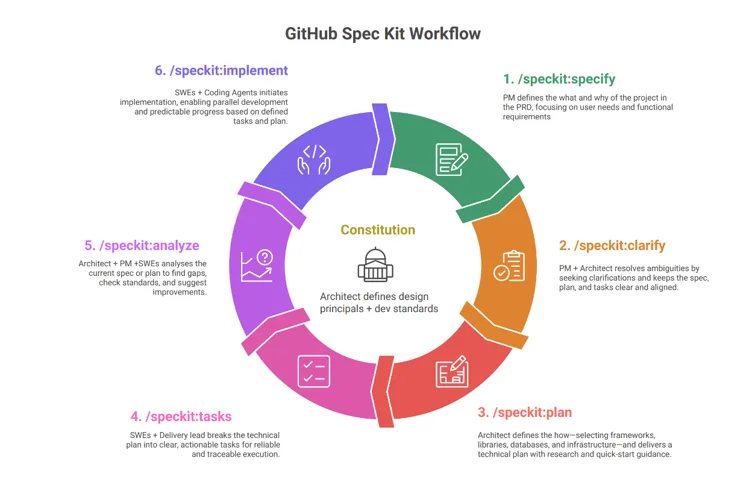
GitHub Spec Kit Engineering lifecycle
The lifecycle is simple: define intent, remove ambiguity, plan with constraints, implement with AI, and validate against the spec.
- Constitution – Define principles, standards, and guardrails.
- Specify – Capture requirements, scenarios, and acceptance criteria.
- Clarify – Resolve ambiguity, dependencies, and edge cases.
- Plan – Translate intent into architecture, flows, and constraints.
- Tasks – Break the work into implementation-ready units.
- Implement – Use AI to generate and refine code and tests.
- Validate – Verify that the output matches the spec.
Each step reinforces the next, which makes the workflow more predictable and easier to scale across teams.
What we learned in practice
Across teams and use cases, a few practical lessons stood out:
- Alignment is a team habit, not just a tooling choice.
- Good specs capture intent, constraints, and acceptance criteria, not just structure.
- Planning has an outsized impact on implementation quality.
- More clarity early usually reduces total delivery time.
- Not every change needs the full lifecycle, so adoption should be right-sized.
The quality of the outcome is closely tied to the quality of the spec. In summary, Spec quality = output quality.
Example: turning repeated onboarding into a scalable pattern
In one of the brownfield projects, the team recognized that onboarding new asset types followed the same basic flow but repeatedly required UI, API, and test changes.
By capturing the reusable pattern in parameterized specs and documenting only the deviations for each new asset, they shifted to a configuration-driven model that reduced onboarding time from 2–3 weeks to a few days.
Example: coordinating a complex multi-service platform
In one of the big greenfield projects, SDD helped the team align PMs, architects, and engineers around a shared vocabulary before building a globally distributed platform spanning thousands of moving parts across attendees, facilities, security, vendors, logistics, and compliance.
By treating the constitution, specs, and plans as the source of truth, the team improved cross-service consistency, made architectural constraints explicit, and reduced execution churn as implementation scaled across components.
Example: moving from prototype to working product faster
In another brownfield project, the team used SDD to move from a React and TypeScript prototype to a working product with multiple agents for DRI, Provisioning, and Policy, plus connectivity health monitoring and admin dashboards.
The structured workflow made it easier to validate AI-generated output against visible UI behaviour, and the team strengthened adoption with custom prompts and quality-gate scripts that made the process more repeatable across contributors.
How teams can get started with SDD
Teams do not need to adopt the full SDD lifecycle at once; a small, focused pilot is often the best way to learn what works in practice. Below is a simple 4-step playbook for adoption.
- Pilot – Start with one feature or workflow where alignment problems are visible.
- Formalize – Create a lightweight spec that captures scenarios, constraints, and acceptance criteria.
- Iterate – Use AI to generate implementation artifacts from that shared context.
- Refine and scale – Review the output against the spec and refine the workflow as you learn.
Keep the process lightweight at first. Treat specs as living artifacts, avoid over-specifying too early, and expand the workflow only where it adds clear value.
Why this matters now
Software engineering is moving from AI-assisted tasks toward AI-native workflows. As that shift continues, the limiting factor is no longer how quickly code can be generated. It is how clearly intent can be captured, shared, and validated across the lifecycle.
SDD gives teams a practical way to reduce translation loss, align around shared intent, and use AI more predictably across the lifecycle—enabling faster delivery, better quality, and stronger alignment.


Shame on you for peddling an obsolete development model based on the model abilities available in mid-2025. SOTA coding agents and LLM models in June 2026 can perform the steps autonomously in the spec-kit much cheaper, much better and much faster. The human gates in the middle is just hindrance to progress.
ur conflating implementation autonomy with decision autonomy. human gates do not exist because AI agents are incapable of performing the work, they exist because enterprise software operates under constraints of risk management, compliance, legal accountability, governance, security, and business responsibility, as agents become faster and more autonomous, their ability to amplify mistakes scales alongside their ability to create value.
In critical systems, the role of humans is not to write every line of code. It is to own the decisions that the code ultimately implements. When a regulatory issue arises, a security incident occurs, or a business-critical workflow breaks, organizations...
Given the explosions in cost because of UBB, is SDD still an efficient method? Is there some data available on the typical cost today vs the PRU cost model?